AI is no longer a buzzword in restaurant delivery, and it is no longer optional for brands that want to scale without adding labor and complexity. We are already seeing measurable outcomes from AI-powered delivery operations, including deployments in which operators reported saving teams time, increasing speed of deliveries, and reducing costs after moving off legacy dispatch workflows. In 2026, Cartwheel is leaning further into AI to help restaurant brands move faster, run leaner, and deliver a more consistent guest experience.
Our focus this year centers on three areas where AI provides the greatest advantage.
1) Enterprise pizza brands are moving from legacy stacks to modern partner ecosystems, and delivery needs an AI layer
Enterprise pizza is in the middle of a technology transition that closely mirrors what other categories have gone through earlier. Legacy all-in-one systems are giving way to cloud platforms and best-of-breed partner ecosystems, where brands choose the strongest solution in each layer, such as POS, digital ordering, loyalty, catering, and analytics, and then integrate them into a unified operating model.
This shift creates a gap that matters more than most people realize, because for delivery-based brands, the dispatch system touches every delivery order and every off-premise guest experience. Brands can modernize ordering and POS, but if the final leg of the journey still runs on rigid rules and manual workflows, the entire operation feels like a legacy stack again.
Cartwheel already serves as the AI delivery layer in this modern partner ecosystem, helping pizza brands modernize the full delivery workflow, not just the front end, and in 2026 we’re doubling down on that work alongside partners like Olo, Toast, PAR, Qu, DoorDash, and others.
The industry has moved beyond a single-fleet mentality where a brand either runs in-house delivery or outsources everything. Leading operators now treat delivery as a routing problem and use software to determine the best option for each order based on economics and execution.
Cartwheel’s focus in 2026 is to help brands advance that model through AI-powered orchestration that reduces store workload and improves performance during peak periods.
- AI dispatch reduces manual coordination in the store and supports consistent execution when volume spikes.
- One deployment reported roughly three hours of manager time saved per store per day after moving off a legacy workflow.
- The system performs better when it balances real-time capacity with service expectations, rather than relying on static routing rules.
2) Delivery 3.0 is coming, and the winners will be ready with the proper infrastructure
Delivery is evolving in clear stages. Delivery 1.0 meant choosing a single model, either in-house or fully outsourced, and Delivery 2.0 is the shift happening now as brands adopt hybrid orchestration that routes orders between in-house fleets and third-party partners based on real-time economics and capacity.
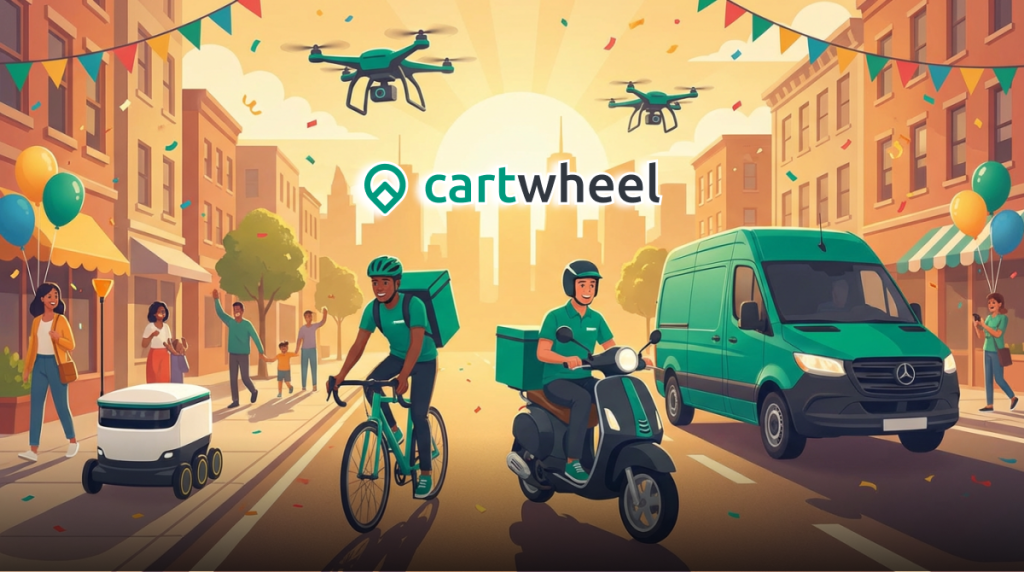
Delivery 3.0 is next, as autonomous modes will gradually join that routing mix. Robots, drones, and other autonomous options introduce new physical and operational constraints, so brands will not win simply by signing a contract with a robotics provider if their dispatch layer cannot make smart decisions across fundamentally different delivery modes.
The point is not replacing human drivers. The point is to build dispatch intelligence that can route each order to the best available mode in real time, which requires infrastructure most brands do not yet have.
- Delivery 3.0 adds autonomous modes to the orchestration layer, which increases the complexity of routing decisions.
- Dispatch systems will need to reason about what is being delivered because weight, volume, packaging format, and route feasibility matter for autonomous options.
- Brands will realize the greatest value when autonomous delivery becomes another lane within the same workflow, with a unified guest tracking experience.
3) Data and visibility make AI operational, not theoretical
AI is only as strong as the operational visibility behind it, and delivery operations require clean inputs and consistent measurement, even before you introduce autonomous modes. Brands need reliable signals for pickup readiness, accurate address data, and clear performance measurement across fleets, because ETAs break when the system is blind to what is happening in the kitchen or on the road.
Cartwheel’s focus in 2026 includes deepening the data and reporting foundation that makes delivery intelligence usable day-to-day.
- Dispatch decisions improve when order details, pickup readiness signals, and address quality are consistently reliable.
- Orchestration improves when outcomes such as on-time performance, reassignment rates, and cost-to-serve are measured consistently across fleets.
- AI improves when delivery outcomes feed back into routing and assignment logic through learning loops that reflect reality.
AI is becoming the operating system for delivery, and we expect the gap between brands that run delivery as a manual workflow and those that run it as an orchestrated system to widen in 2026. Cartwheel is focused on helping enterprise brands, starting with enterprise pizza, modernize delivery operations with AI, and we are focused on helping them build the infrastructure that makes Delivery 3.0 a competitive advantage rather than a future headline.