

Three Lessons from the Restaurant Catering Workshop: How to End Catering Delivery Chaos

Catering delivery can get complicated fast. A large order is ready, but there’s no driver available. A customer calls for an update, and the restaurant team is trying to track down the delivery. Meanwhile, orders are coming in through different platforms, each with its own process.
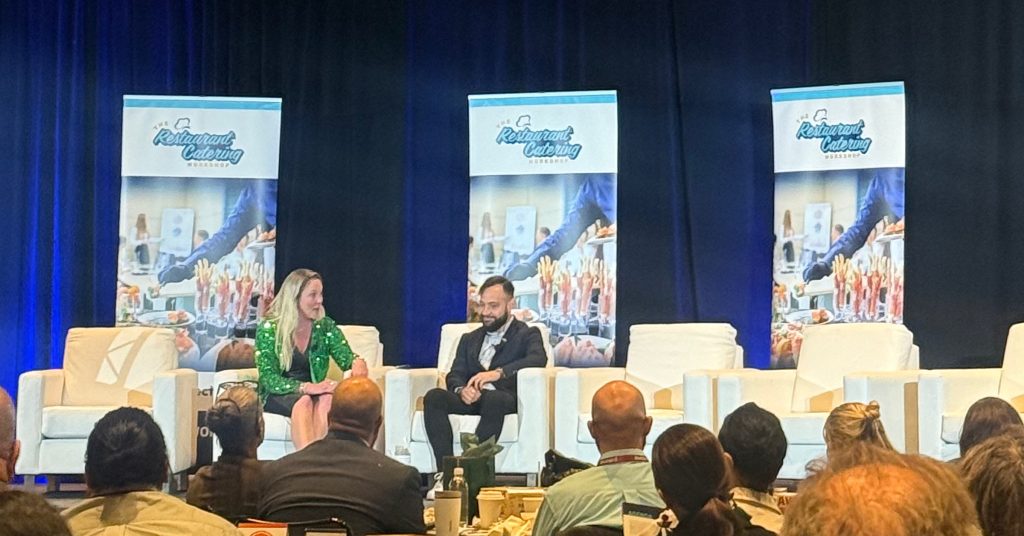
These challenges were familiar to the operators attending this year’s Restaurant Catering Workshop in Arlington, Texas. When Cartwheel co-founder and CMO Magdim Metshin brought them up during his Lunch & Learn session, The End of Catering Delivery Chaos, hands went up across the room.
The session focused on three practical ways restaurants can avoid these situations: having backup delivery capacity, giving customers consistent tracking, and managing multiple delivery providers without adding complexity for their teams.
Lesson 1: Build the backup before you need it
One of the worst times to discover you don’t have a driver is when a large catering order is already packed and ready to leave.
At that point, the options are limited. A manager can make the delivery, the customer can pick it up, or the order goes out late. None of those is a particularly good solution, which is why having backup capacity in place ahead of time matters.
For years, restaurants treated delivery as an either-or decision. Either you run your own drivers or you use third-party fleets. But there’s no reason you can’t do both.
In-house drivers know your food, your operation, and your customers, and for many brands they’re the preferred choice. The challenge is that catering demand isn’t always evenly spread throughout the day. You might have enough drivers all morning, then suddenly have three large orders that need to leave within the same 30-minute window.
A hybrid delivery model lets restaurants prioritize their own drivers while keeping trusted third-party providers available when they need extra capacity.
Just as important is how that backup gets activated.
If your team has to monitor every order, notice when a driver isn’t available, and manually request another provider, you’re already losing valuable time.
With Cartwheel, for example, if an order assigned to an in-house driver isn’t accepted within a set window, the system can automatically send it to a trusted third-party provider. The team doesn’t need to intervene, and the order can move forward without the usual last-minute scramble.
The goal isn’t to replace your own drivers. It’s to make sure one unavailable driver doesn’t put an entire catering order at risk.
Lesson 2: Track every delivery, including your own drivers
Most third-party delivery providers already offer tracking. But when restaurants use their own drivers, that same visibility isn’t always available.
From the customer’s perspective, the distinction shouldn’t matter. Whether their order is coming with an in-house driver or a third-party provider, they should be able to see where it is and when to expect it.
This is especially important for catering. When someone is responsible for feeding 50 or 100 people at a specific time, even a small delay without an update can create uncertainty.
At the Catering Growth Forum earlier this year, an executive assistant at Amazon who regularly orders catering shared how much proactive communication matters. Ideally, she wants a message on the morning of delivery confirming that everything is on schedule, followed by real-time driver updates once the order is on its way.
That level of communication shouldn’t be the exception.
Marketplaces are also raising expectations. Some marketplaces now charge tracking fees on orders that aren’t fully tracked, and research shows that 95% of customers want tracking updates on every catering order.
For restaurants, that’s a good reason to make tracking part of their standard delivery process, not just something they provide when a marketplace requires it.
After all, customers ordering directly from your restaurant shouldn’t get less visibility than those ordering through marketplaces.
Consistent tracking also makes life easier for restaurant teams. Instead of fielding calls from customers and chasing drivers for updates, everyone can see what’s happening with the delivery.
And when something does go wrong, having that visibility makes it much easier to respond.
Lesson 3: One operation, not one process per channel
Catering orders can come from several places. Some arrive through a restaurant’s website; others come through ordering platforms. Each channel may have a different delivery workflow, and the providers handling those orders often have their own systems and procedures.
For a busy restaurant team, that can mean switching between platforms, managing deliveries in several places, and following different steps depending on where the order came from.
The answer isn’t necessarily to use fewer delivery providers.
In fact, having multiple providers is often an advantage. No single fleet will be the best fit for every order, market, or situation. One provider might have better coverage in a particular area, another might specialize in large catering orders, and sometimes your preferred provider simply won’t have capacity.
Working with multiple trusted providers gives restaurants more flexibility and another layer of backup.
The challenge is making sure those extra options don’t create extra work for the team.
Instead of managing separate workflows for every order source and delivery provider, restaurants can bring everything into one system.
That means one place to manage orders, assign drivers, monitor deliveries, and handle exceptions, regardless of where the order originated or which fleet is fulfilling it.
The same approach works for brands and locations without their own drivers. They can work with multiple third-party providers without building a separate process for each one.
With delivery orchestration, restaurants can choose the right provider for each order while keeping the day-to-day workflow consistent for their staff.
More delivery options shouldn’t mean more systems to manage or more procedures to learn.
What to take back to your team
During the workshop, Magdim joked about wishing for a magic wand when a driver doesn’t show up for a catering delivery.
Of course, there’s no magic fix for every delivery problem. Drivers get delayed, orders pile up, and last-minute changes are part of running a restaurant.
But much of the chaos comes from solving those problems manually after they’ve already happened.
Having reliable backup capacity, consistent tracking, and one process for managing deliveries can make a big difference in how restaurants handle those situations.
The result is fewer last-minute decisions for the team, better visibility for customers, and a catering operation that’s easier to manage as order volume grows.
Want to see how Cartwheel brings in-house drivers, third-party fleets, and specialized catering providers together in one system? Book a call and let’s talk delivery.